
Hybrids are not attenuators
An Austrian Perspective

Hybrids are not attenuators. And they are not rockfall catchment fences. They have characteristics of both, but are unique in function.
Rockfall catchment fences are designed to dissipate 100% of impact energy through interaction with the superstructure alone. They can, more-or-less, be thought of as a plane that is oriented normal to slope where debris is stopped (ignoring elongation of the system). It does so through brute strength and plastic deformation of the posts, bearing ropes, nets, brake elements, etc., that lead all the forces into the ground via anchors.
A 2000 kJ ETAG 27 test carried out for a fixed-post rockfall catchment fence at an inclined test site. During the test, all forward motion of the block must be stopped before any ground contact occurs.
Rockfall catchment fences stop falling debris in the plane of the fence...

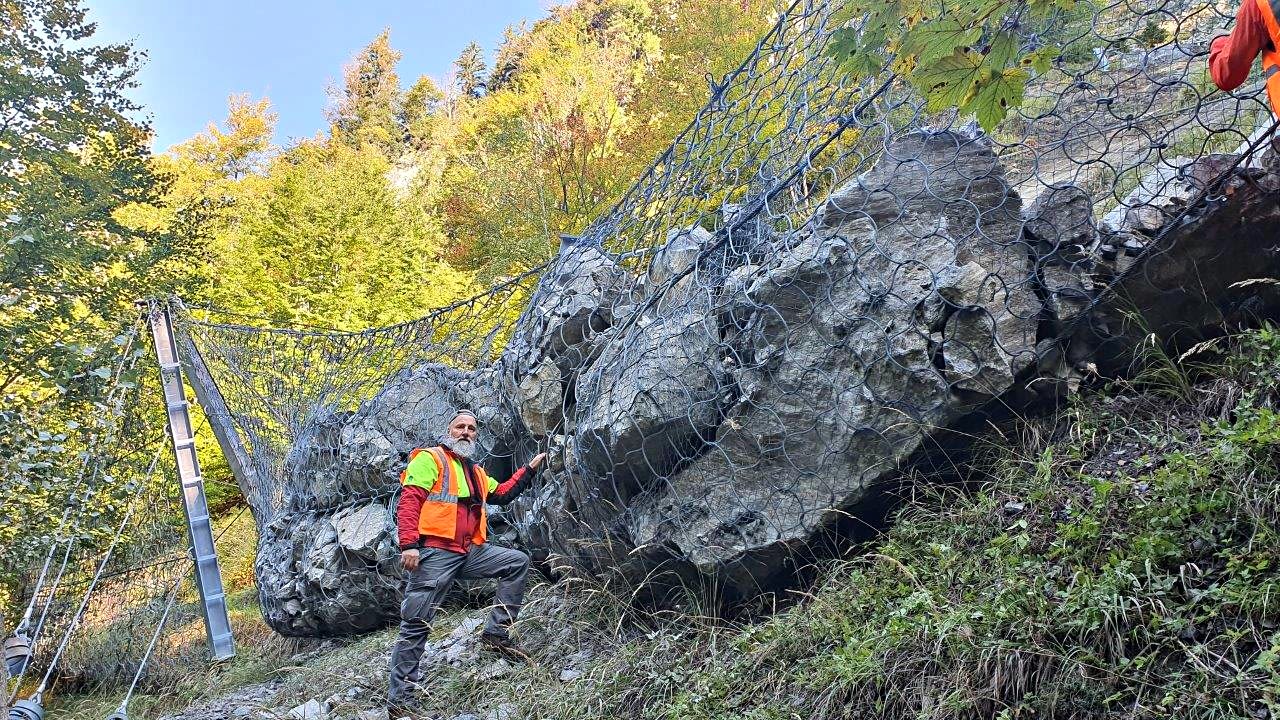
A "rolling rock" test conducted on an attenuator. The test block is a steel-coated, 1.6 m high, 8,700 kg cement block fitted with a gyrometer and accelerometer. The system was impacted 13 times with an average impact energy of approximately 2,700 kJ and where no repairs were carried out between impacts.
An Attenuator does not stop falling debris. It may dissipate some of the energy*, but its primary function is deflection. It relies mainly on the weight and friction properties of the net material and the characteristics of the impact and interacting debris to change trajectories. It has an open bottom boundary which results in the net being heaved up during an impact, as well as the material passing through the system (i.e. debris is not caught). Such systems always requires a secondary catchment structure/area. Loads are distributed to anchors via the bearing ropes and posts. Typically, no brake elements are incorporated into these infrastructure and plastic deformation is very limited.
* tests have shown this varies between approximately 10% - 80% of the initial impact energy and is highly dependent on the geometry and characteristics of the impact.
Attenuators help control falling rocks by deflection, but debris always exits the system and so secondary catchment is required...

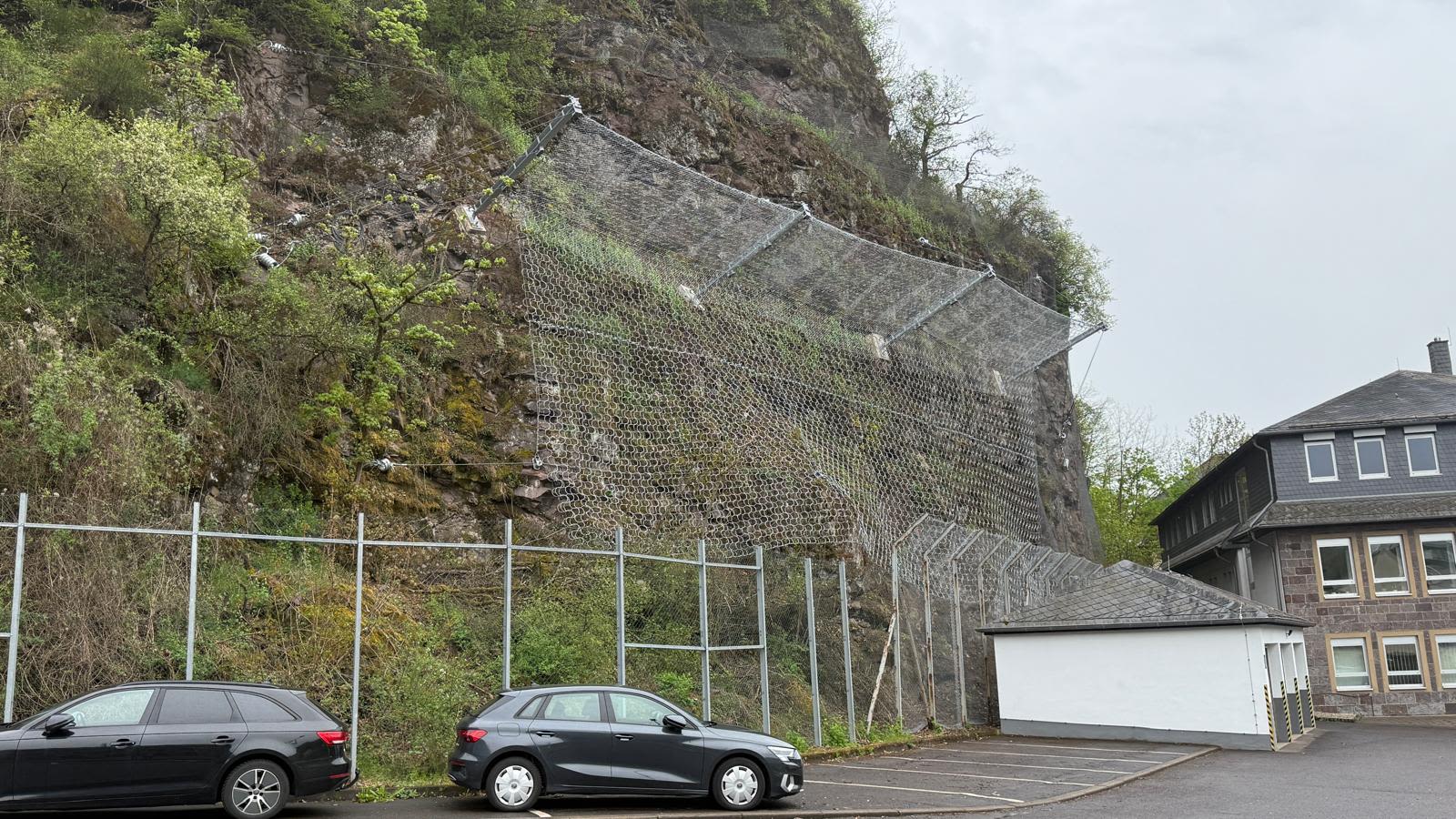
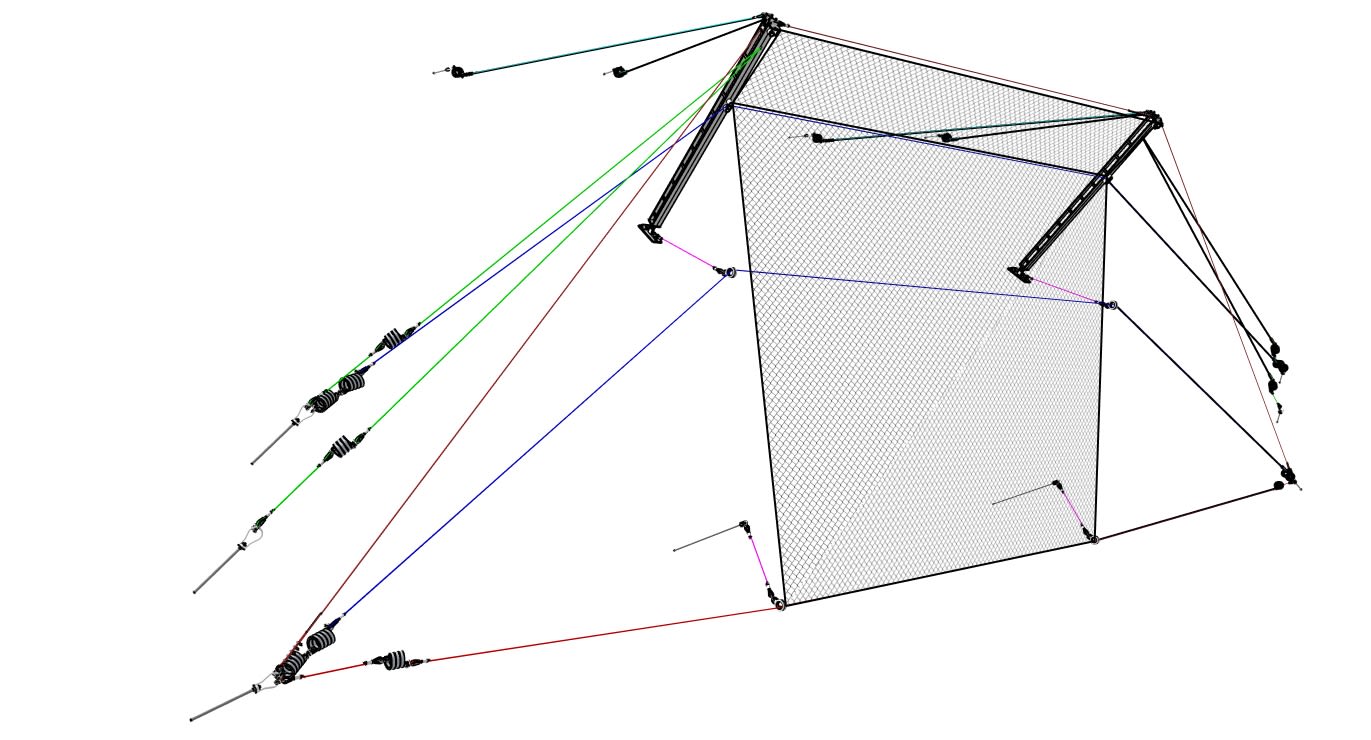
A Hybrid system is a type of rockfall catchment fence that has a slope parallel tail section incorporated into it. 100% of the impact energy is dissipated by the superstructure and the interaction of the debris with the slope. It has bounding conditions that do not allow the debris to leave the system and prevents the net from being significantly lifted. As such, the strength of the individual components and plastic deformation (though less than for a catchment fence) once again become important factors. These systems often share similar components of a typical rockfall catchment fence, which are distributed along the length of the tail.
An ETAG 27 style test conducted on a 1000 kJ hybrid rockfall catchment fence. The system is designed to dissipate up to approximately 80% of the initial energy in the upper impact zone, with the remainder being dissipated by the tail and slope.
Hybrid barriers stop falling debris at the lower boundary of system...

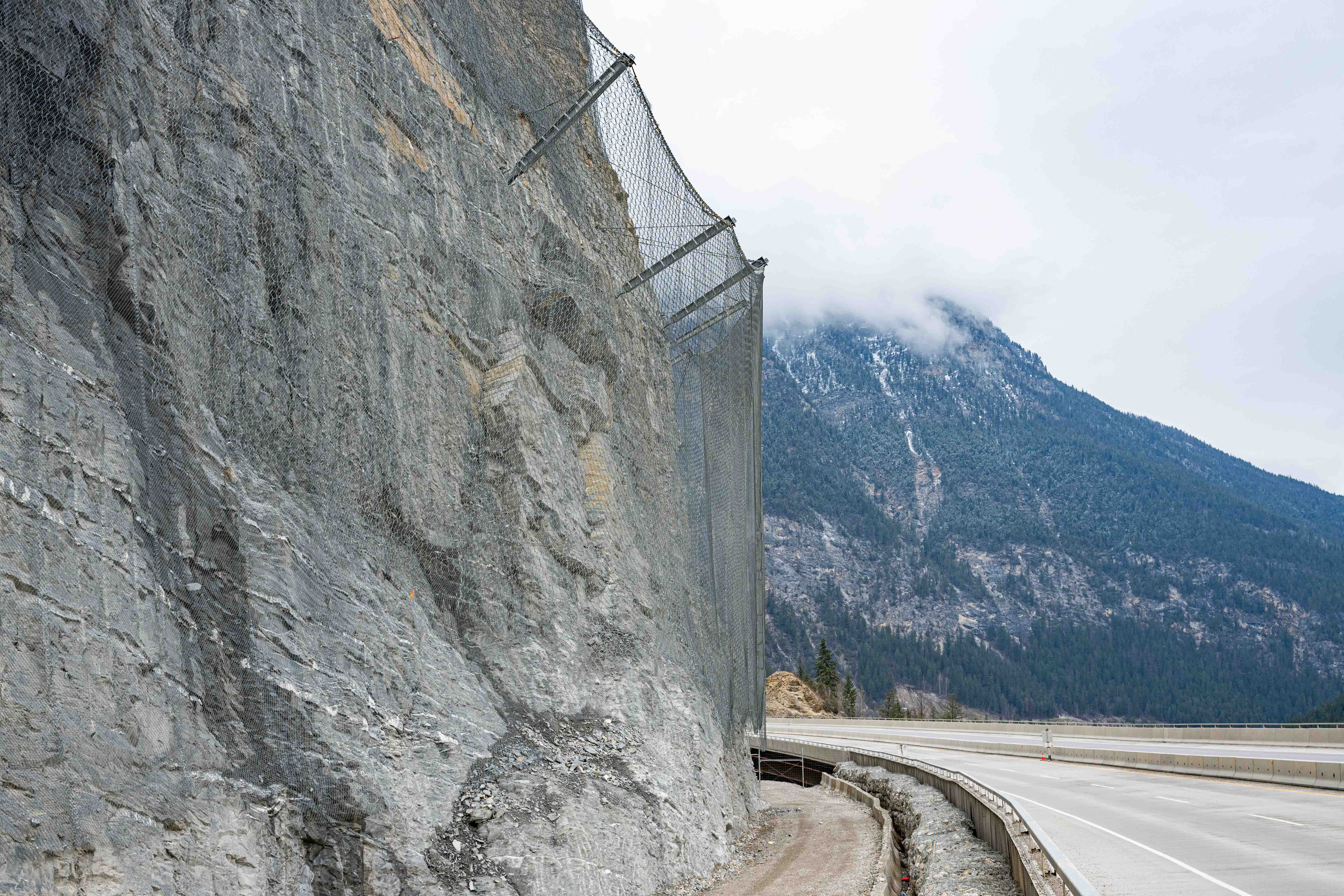
Logger's Slide

Logger's Slide, BC, Canada
Rockfall mitigation was required adjacent to Highway 99 on this highly touristic and vital commuter route along the coast of British Columbia. At this site, the threat of large (>1000 kJ), low-frequency rockfall events is coupled with smaller, high-frequency events that pose a maintenance issue.
An approach was desired that would allow smaller debris to progress down slope where the maintenance contractor could more easily clean out the system, while at the same time providing assurance that larger impacts would not pass through the system and impact the highway. In 2024, Thurber Engineering designed a mitigation solution using a 2000-kJ hybrid rockfall catchment fence that spanned a 14 m gully located approximately 10 m above the road level.
The tail of the system was anchored to floating guides and bottom bearing rope that were located just above the bottom of the slope’s toe. The structure used horizontal middle ropes (with associated brake elements) in the impact zone of the system which, from testing, shows that it can dissipate approximately 80% of the initial energy.

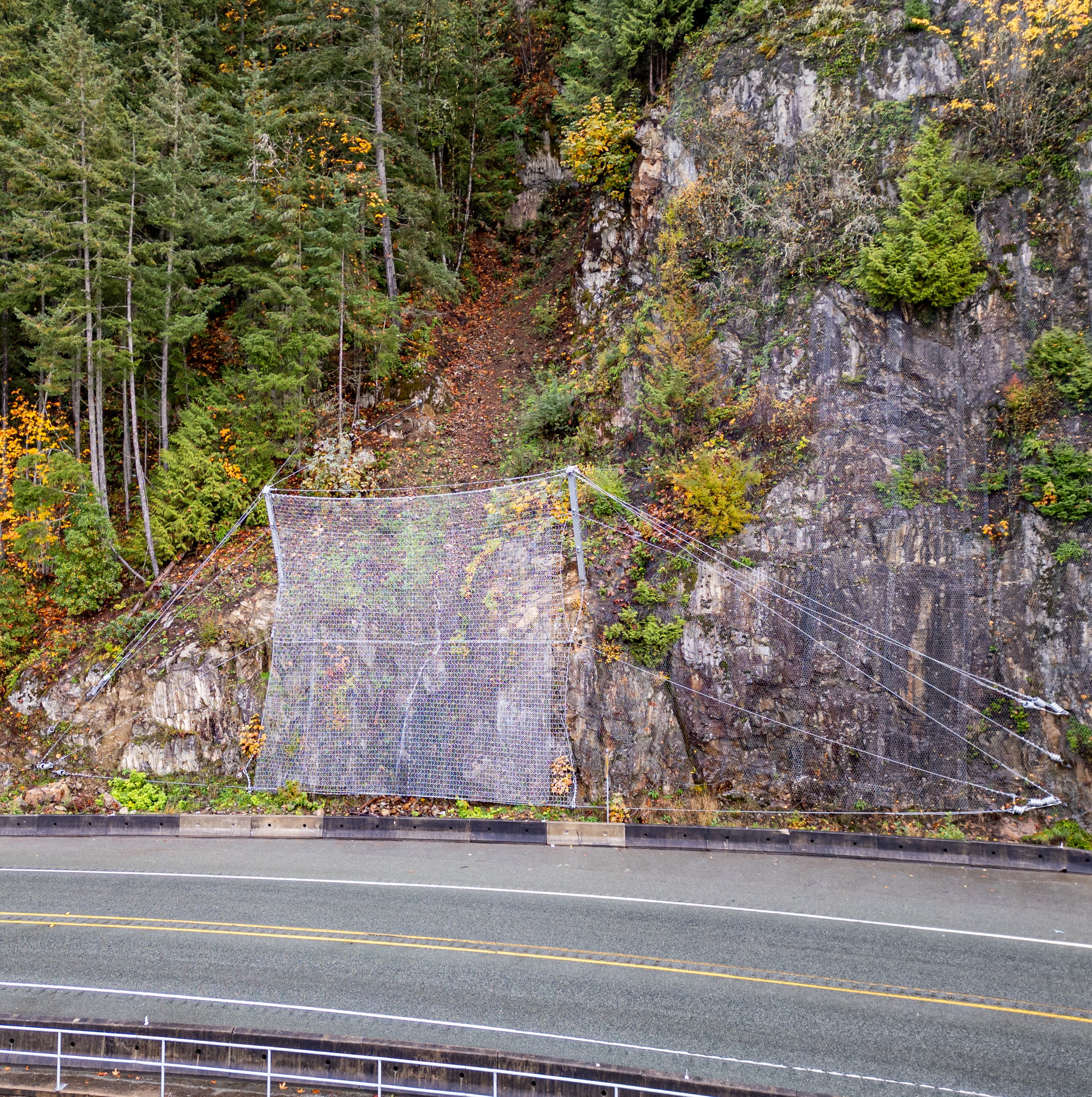
2000 kJ hybrid rockfall catchment fence (TSC-2000-ZD Hybrid) on the Sea-to-Sky highway in British Columbia, Canada
2000 kJ hybrid rockfall catchment fence (TSC-2000-ZD Hybrid) on the Sea-to-Sky highway in British Columbia, Canada

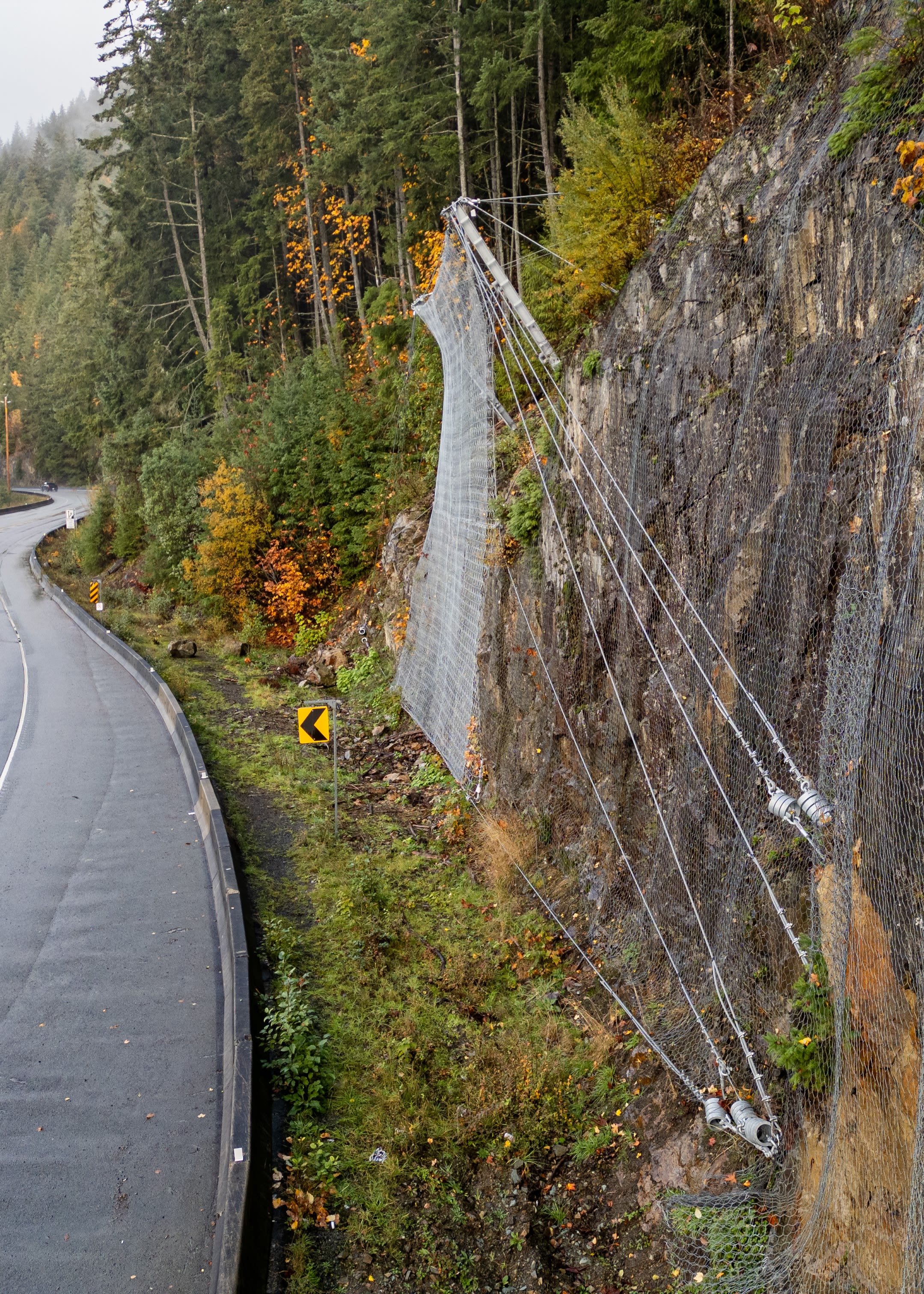
The system allows smaller, frequent rockfalls to be stopped at road level with little to no maintenance with larger, infrequent events also being caught.
The system allows smaller, frequent rockfalls to be stopped at road level with little to no maintenance with larger, infrequent events also being caught.

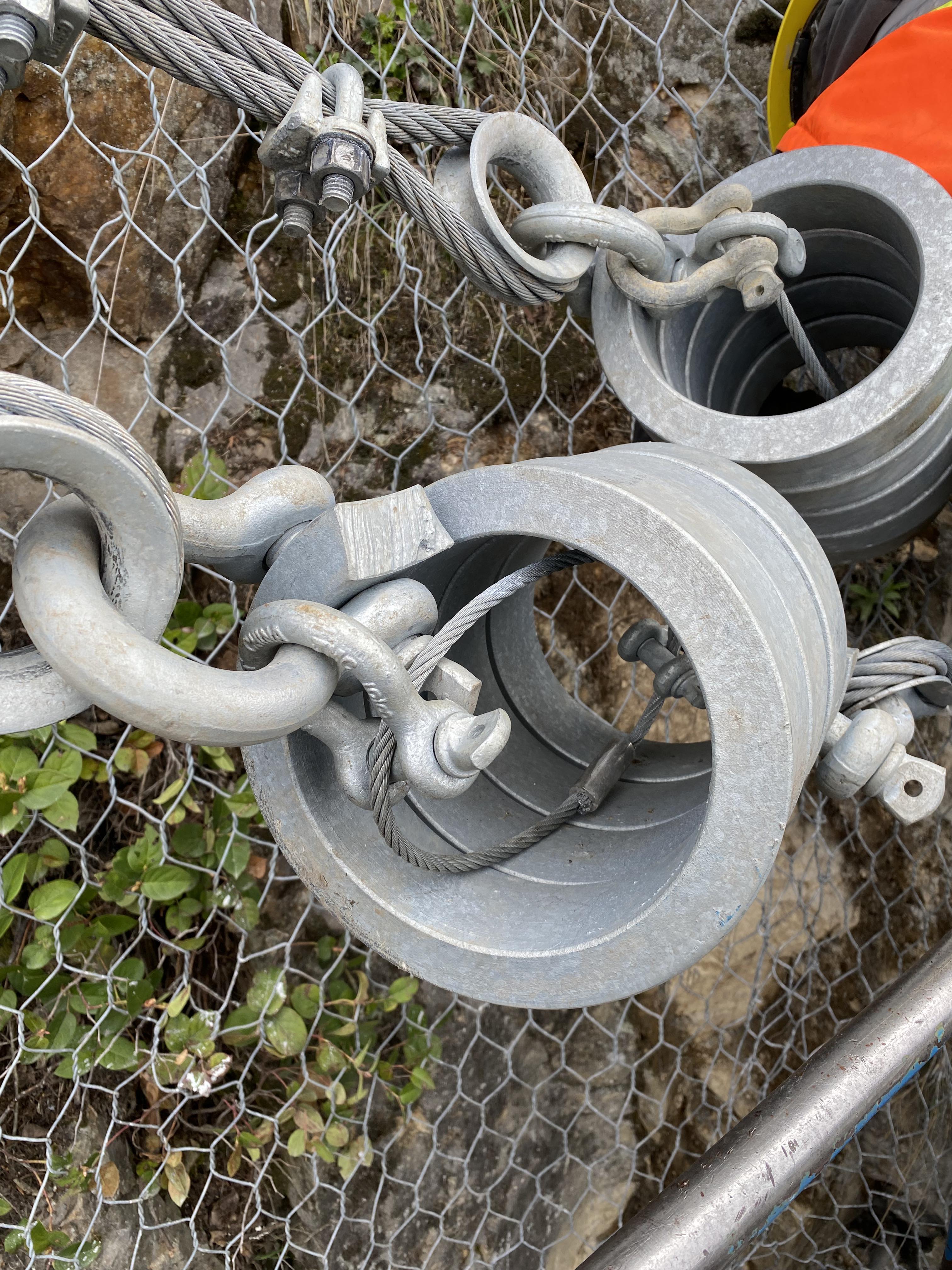
Brake element incorporated into the system using "brake locks" that prevent activation during low-energy, high-frequency events which help reduce maintenance.
Brake element incorporated into the system using "brake locks" that prevent activation during low-energy, high-frequency events which help reduce maintenance.
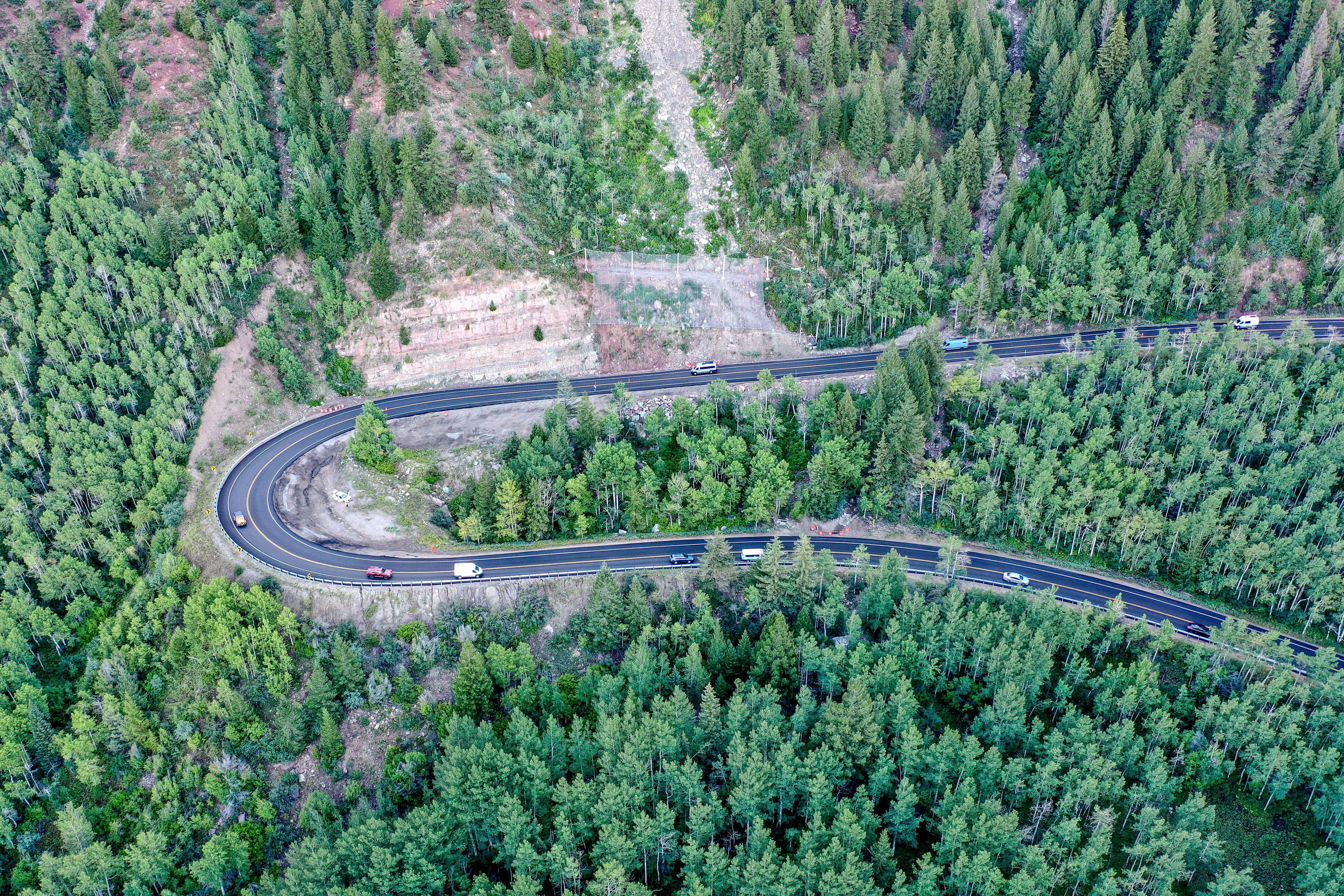
Minturn

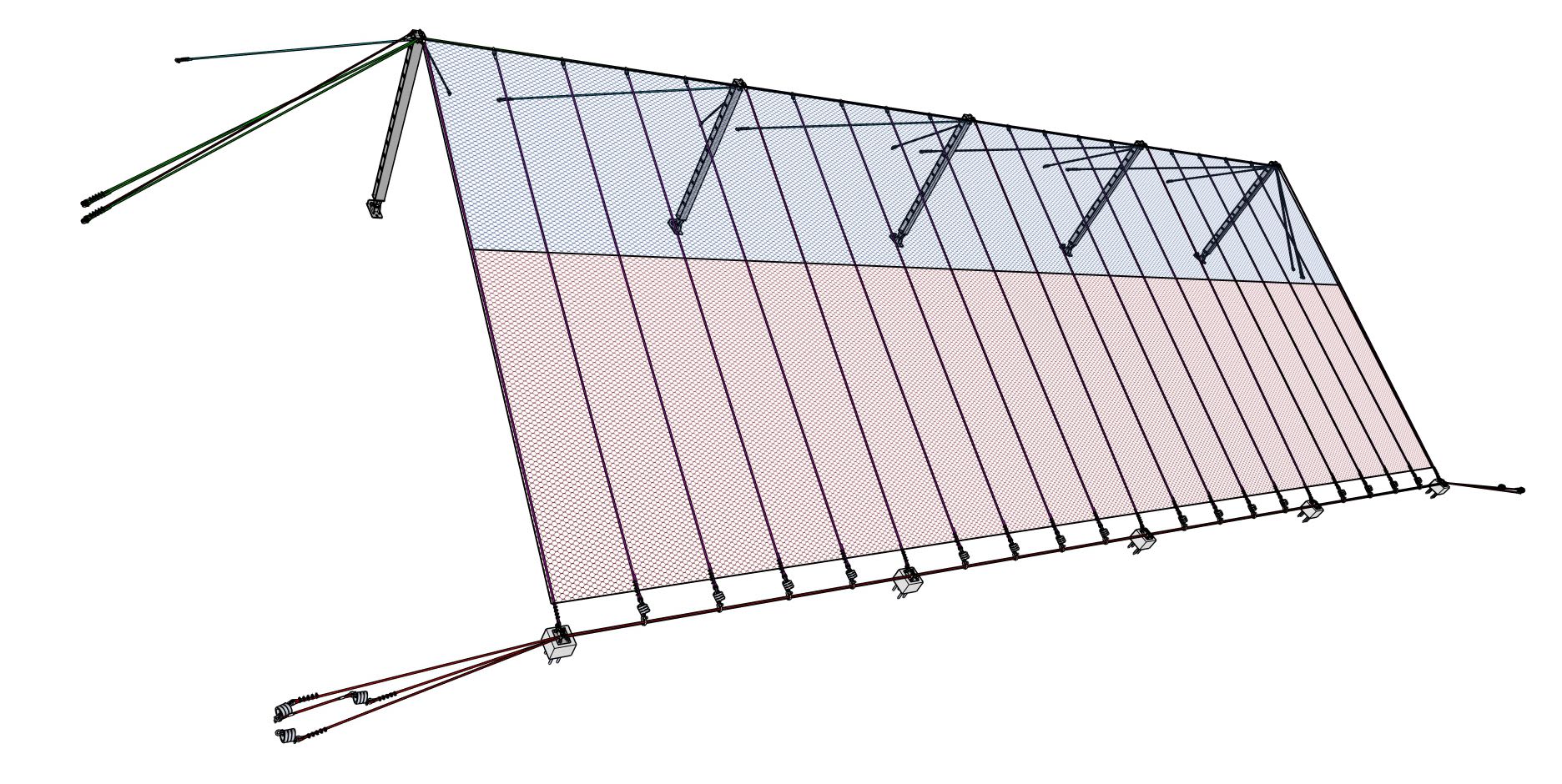

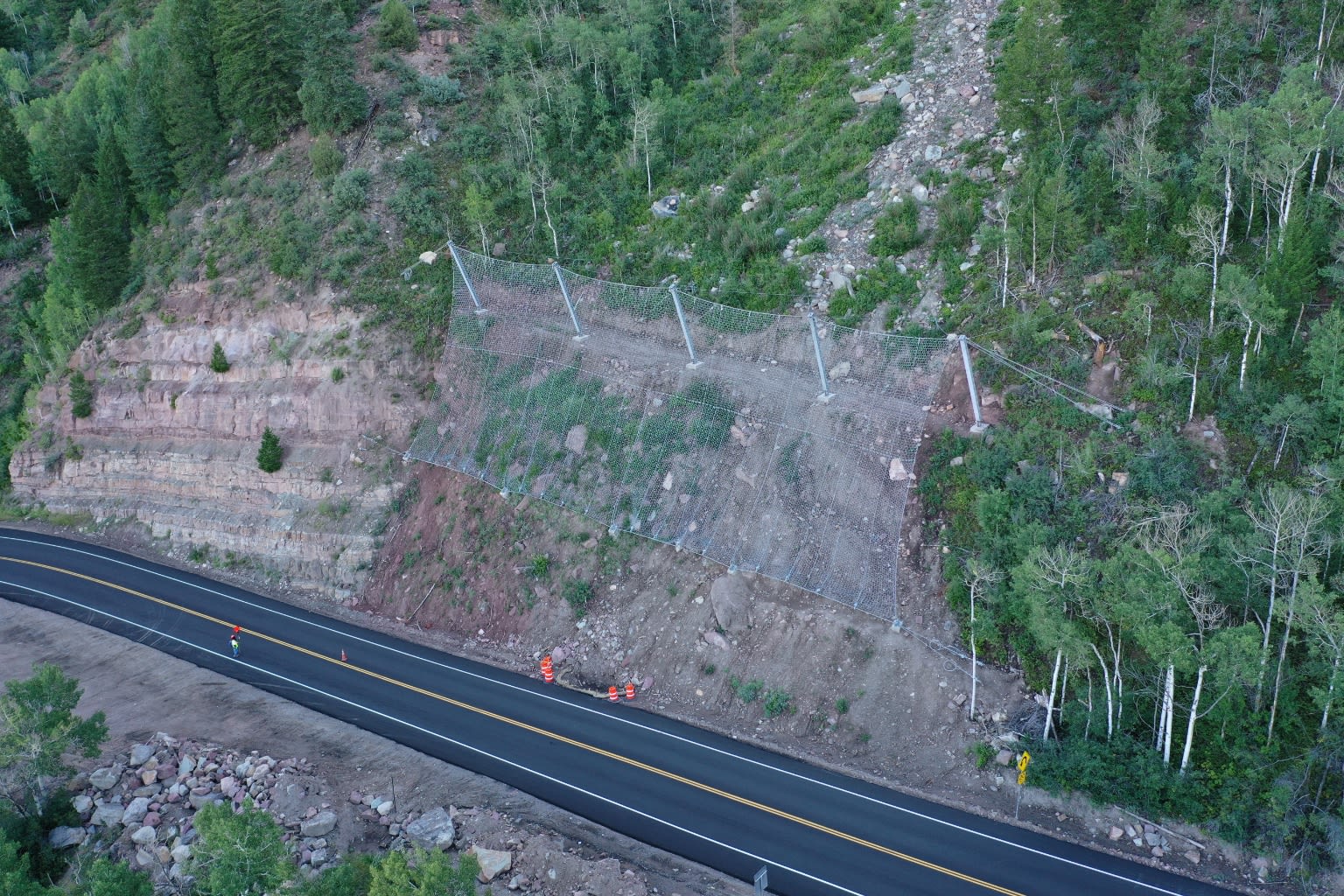
Hybridized TSA-6000-ZD system near Minturn, CO.
Hybridized TSA-6000-ZD system near Minturn, CO.

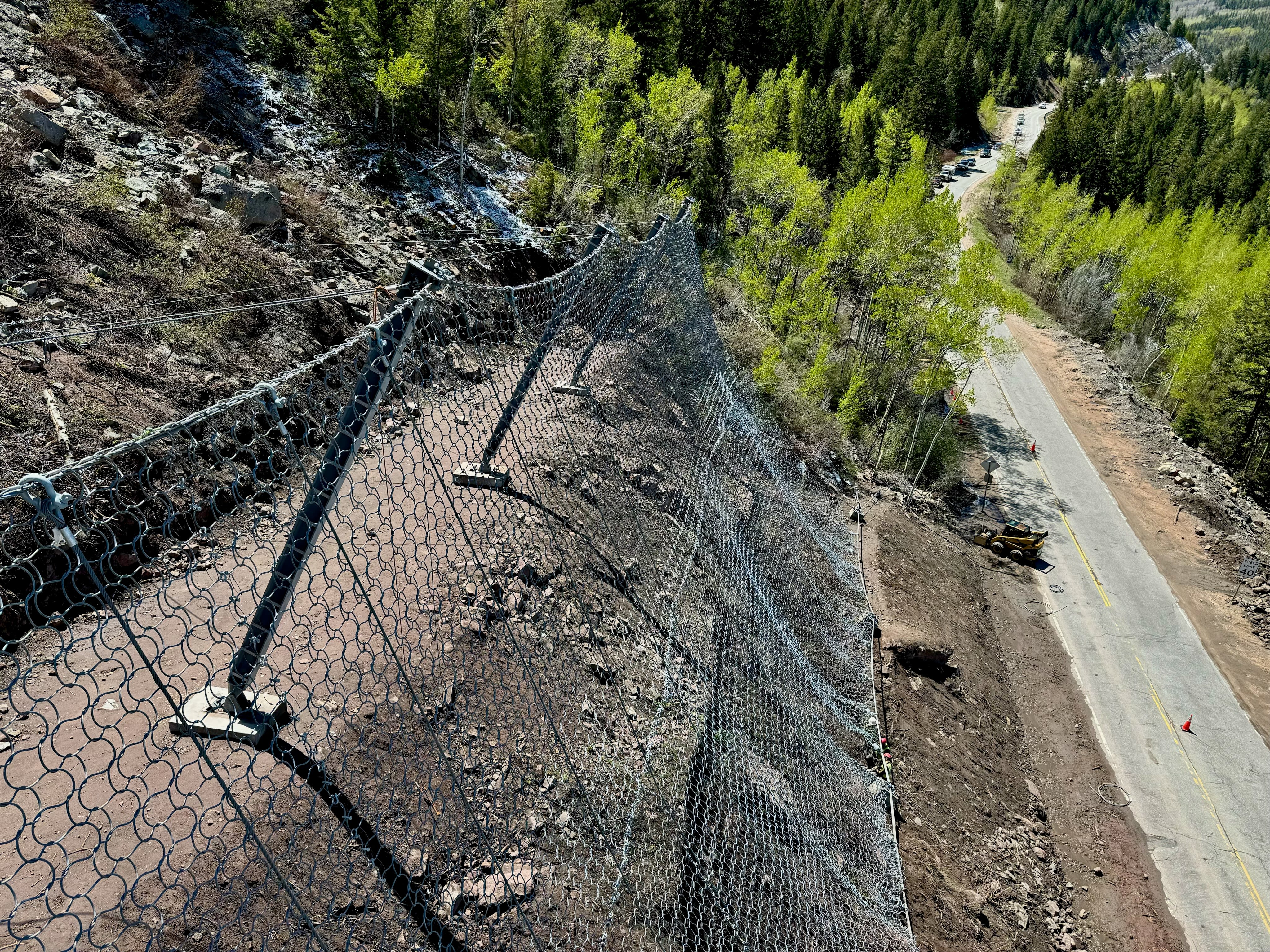
This system uses an upper and lower bearing rope set, forming a plane that is slope parallel. This allows the system to dissipate energy from large impacts while keeping the debris from passing through the system.
This system uses an upper and lower bearing rope set, forming a plane that is slope parallel. This allows the system to dissipate energy from large impacts while keeping the debris from passing through the system.

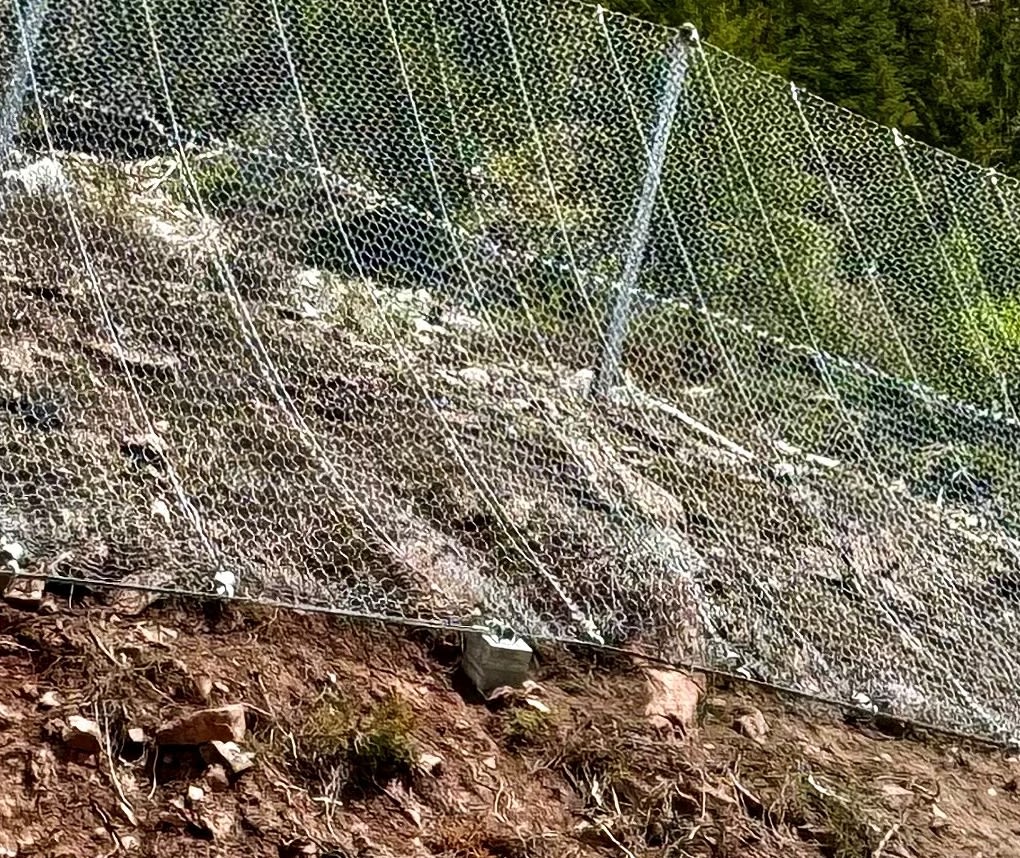
Vertical ropes fitted with brake elements, along with hybrid rope guides, are connected to the lower bearing rope and help control net elongation and dissipate energy.
Vertical ropes fitted with brake elements, along with hybrid rope guides, are connected to the lower bearing rope and help control net elongation and dissipate energy.
Minturn, CO, USA
Along US Highway 24 at Tennessee Pass, approximately 6 km south of Minturn, Colorado, there is a site that has long been affected by significant rockfall activity. The Colorado Department of Transportation installed a series of mitigative measures in the past, including rockfall attenuators.
In 2022, the primary system was destroyed following a major event. In 2024, a decision was made to replace the system with a 50 m hybrid rockfall catchment fence, in this case, a 6000-kJ attenuator that was adapted into a hybrid system. The goal was to provide a system that acts like an attenuator but will stop large debris from reaching the road level, since there was insufficient catchment.
The system used brake elements attached to the lower bearing rope set and vertical ropes, which allows for plastic deformation and controlled elongation of the net. The upper bearing ropes and retaining ropes were all static, (i.e. no brake elements) and so experience minimal elongation. Hybrid base plates, located along the lower boundary of the system, were elevated from the ground level to help promote the movement of small debris beneath the net, but maintain the catchment of larger debris.

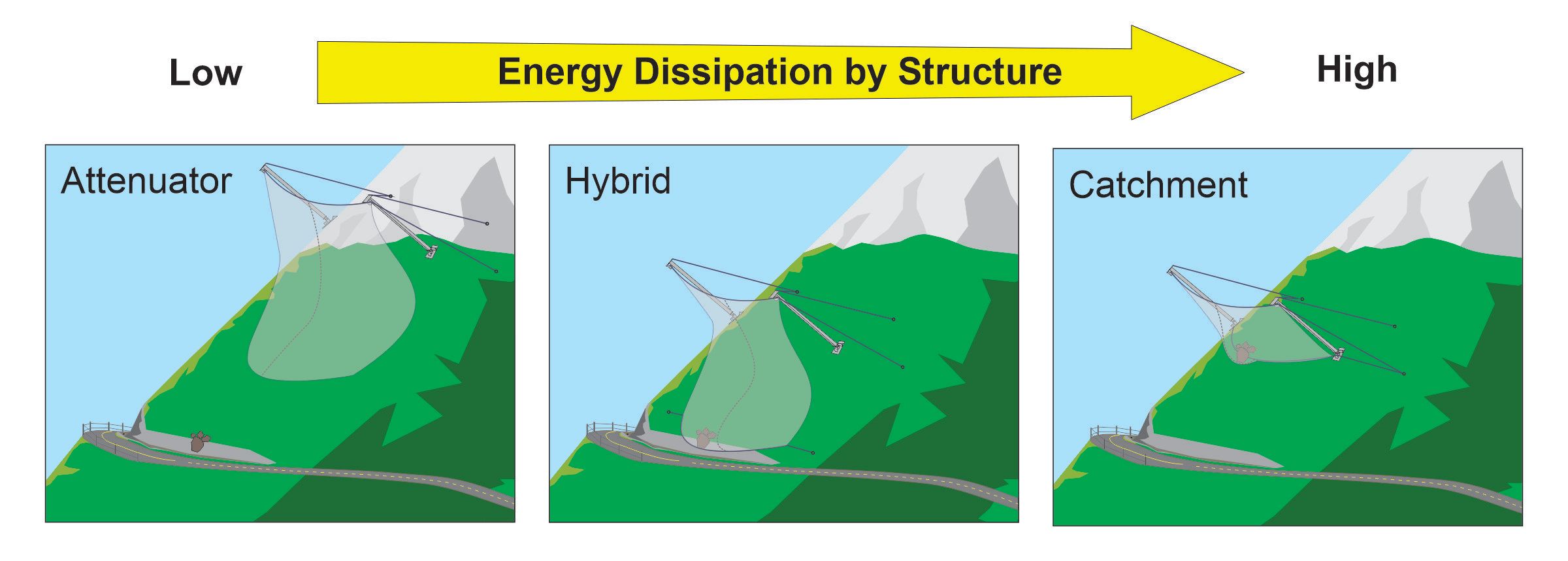
Rockfall protection fence systems can be thought of as a continuum with attenuators and catchment fences as the extremes and where the amount of energy dissipated by the superstructure ("stopping power") increases from attenuators to catchment fences.
Rockfall protection fence systems can be thought of as a continuum with attenuators and catchment fences as the extremes and where the amount of energy dissipated by the superstructure ("stopping power") increases from attenuators to catchment fences.
Summary
Manufacturers and engineers of rockfall mitigation structures use various terminology when describing structures used to help control rockfall, some of which are in direct conflict with one another. This has led to confusion in the industry and has important implications for specifying products during design and tendering stages of a project.
From an Austrian manufacturer's perspective, if a rockfall catchment fence and an attenuator are thought of as two opposite ends of the spectrum of rockfall fences (i.e. systems with posts), then a hybrid is a system that incorporates characteristics of each structure. It uses both the structure itself and the slope to dissipate energy and stop falling debris within the confines of the system.
But no matter what you call them, it is important to understand the function of the system and to chose the correct system that best meets the needs of the site.


Ahren Bichler, M.Sc., is the General Manager of Trumer Schutzbauten Americas Ltd. and is the past-president of the Association of Geohazard Professionals. He is a Quaternary geologist that has worked with natural hazards for more than 20 years in Canada, the United States, South America, Australia, New Zealand, Germany and Austria.
Trumer Schutzbauten Americas Ltd.
720 - 999 West Broadway
Vancouver, BC
Canada V5Z 1K5
a.bichler@trumer.cc
+1(604)732-0325
www.trumerschutzbauten.com
Advertisement

 Built with Shorthand